
This is Part 2 of the previous blog that began by posing the question, “Where Are You?”
In Part 1, we saw how your neurology translates light waves and sound waves into projected visual and auditory experiences that convince you that where you are is someplace out there. But before we can arrive at a complete answer to the question of where you actually are, we need to explore the last three sense modalities. Part 1 finished by noting how two of these three sense organs are, like vision and hearing, located completely inside your head. Let’s take a look at these two…
When you taste a ripe peach, you never think, “The sweetness is over there on the tree.” Before you can experience this sweetness, the molecules of the peach must enter your mouth, dissolve in your saliva, and wash over your taste buds. The flavor then explodes on your tongue inside your head. Your neurology never projects taste out into what you perceive as the world. Taste is the most internal or “local” of your senses and the most honest, at least in where it’s always experienced.
Smell is also internally experienced, though it has an aspect of locational projection. When you’re camping with your grandson and you catch a whiff of woodsmoke on the wind, you point in its general direction and ask him, “Can you smell that campfire? It’s somewhere over there.” Earlier in human evolution, the sense of smell was likely more directionally acute for the purpose of survival. But now, when you smell a skunk in your backyard late at night, your first thought is, “Where the hell is it?”
Taste never projects, and smell can’t project precisely. Yet, despite being separate sense modalities, they’re like vision and hearing in how they often work together to produce what you experience as a uniform sensation. But while vision and hearing always project sensations, taste and smell work together to generate a sensation that’s about as local as it gets for you… right smack in your mouth.
So, neither taste nor smell are as culpable as sight and hearing in misrepresenting your true location. That leaves touch. Since the skin’s touch receptors are further out in the perceived world, they can be thought of as the crucial leading edge of your interface with the world. Could it be that because it’s the only sense modality not housed completely inside the skull, your sense of touch is somehow immune from neurological projection? Let’s see…
Reach out and touch your desk, or the mug there in the coffee house, or the wooden seat you’re sitting on in the park. Better yet, reach out and touch the thing you touch most often. You know what it is. Is it possible that the sensation of touching this object you hold so dear is a projection? If you’re reading right now on this device, get a firm grip on it as we see what science says is actually happening as you hold your phone.
Physicists tell us that all matter is composed of extremely tiny atoms separated by an immense amount of empty space. Then why doesn’t your hand just pass through the phone? Here’s why: The atoms on the surface of your fingers and the atoms on the surface of your phone both contain negatively charged electrons. Like two magnets with their negative sides facing each other, your fingers and phone repel each other with great force when they come close enough to each other.
This “close enough” threshold is a zone of repulsion that feels to you like you’re touching your phone, or your coffee cup, or even your partner’s lips. You can come very, very close to an external object. But you can never come in direct and intimate contact with what the object feels like it is. This may be the hardest neurological translation to accept. Here’s a metaphor that might help…
A screen door’s metal grid is mostly open space and almost invisible at certain angles in the right light. But if you try to push your hand through the screen, it resists as if it’s a solid, uniform surface. Take your phone out and touch its cool glass surface while you look at the image below. Think of the wire screen as representing the zone of negative repulsion between your finger and the phone.
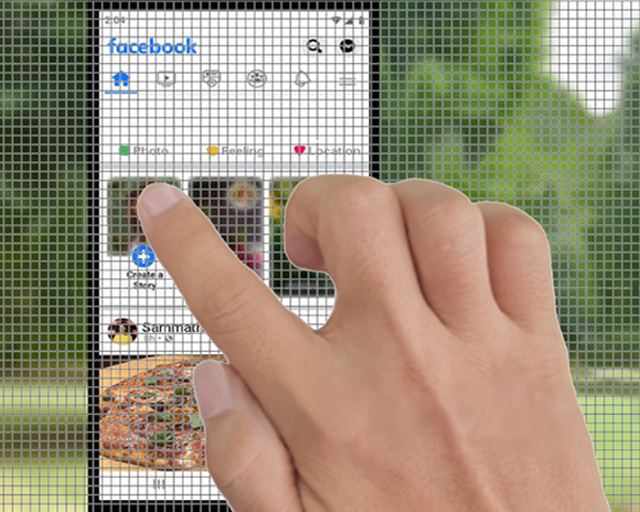
Here’s what’s happening: Heat can be thought of as the speed of molecular vibration. The faster-vibrating molecules of your finger conduct some of this heat across the zone of negative repulsion to the slower-vibrating molecules of your phone’s glass surface. Your neurology translates your finger’s lost vibration into your experience of coolness. Touch your phone’s cool surface again and realize that you’re only experiencing your own finger’s lost vibration. Despite its solid and reassuring “feel,” you never really come in contact with your precious phone.
So, like vision and hearing, touch only seems to reach out there. Despite the illusions generated by our three primary sense modalities,we’re actually encapsulated in an invisible barrier — a bubble of perception — that prevents us from ever directly contacting what appears to be the external world. The “screen” metaphor can be used in two ways to illustrate what science says about the illusions of human perception. When applied to our sense of touch in the image above, this metaphor can be likened to a wire screen that prevents us from ever directly contacting the world.
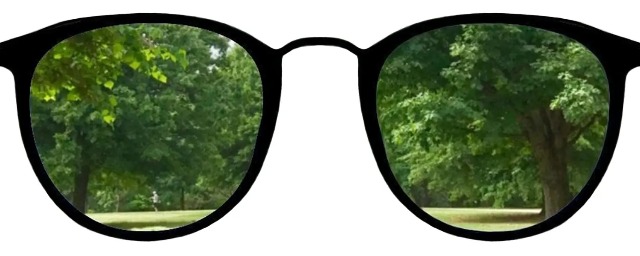
When applied to vision, this screen metaphor is similar to how prescription eyeglasses fool us. Though it seems that we’re looking through eyeglasses, the image our neurology is processing is actually on the inside surface of the lenses, as illustrated in the image below. The lenses function as a kind of TV or computer screen. In a similar way, we can only see the external world as it’s displayed on our perception bubble’s inside surface… its screen. But unlike eyeglasses, we can never take this screen off.
Our eardrums can be thought of as the last important part of this bubble of perception. Sound waves vibrate the bubble, allowing our neurology to generate the illusion of hearing at a distance. Of course, the “bubble of perception” is only a concept. But it may help us remember how our neurology orchestrates the illusions of sight, hearing and touch to convince us that we’re directly experiencing what appears to be the external world. Let’s see if this concept can help answer the question…
Where are you?
As we’ve seen, your most fundamental location is not your home office, a coffee shop, or a park bench. You’re “screened” from these locations and only experience them from within your bubble of perception as neurological translations. This conceptual bubble represents where you are now, have always been, and will always be. Realizing this can be somewhat unsettling, but don’t worry. No conceptual realization can interrupt your brain-generated illusions for more than an instant.
But wait… before you’re projected back out there, hold on to the reality of perception for a few more seconds. Try on the bubble. Feel it, not as a concept but as if it’s clinging to your face. Realize that the text you’re peering at right now is not on a screen a foot or so away. It’s on the inside “screen” of your perception bubble directly up against you. Feel the tension around your eyes and in your neck muscles as you try to peer through this invisible bubble and escape a feeling that borders on the claustrophobic. There’s a reason this exercise feels so confining…
Your brain’s projection of real time visualization has conditioned you to also project as you visualize past events and future scenarios. So, you project when you perceive in real time, and also when you imagine and remember. This near constant projection takes your sense of self along for the ride, pasting against your face and chest most of time that you’re awake. You rarely feel the sensation of actually occupying the back part of your body, except for the few seconds it takes you to position yourself in your car or in a chair… or in bed, before you fall asleep, dream and project some more.
Because your sense of self — the actual sensation of existence — is very likely plastered up against the front of your bubble right now, trying on your bubble can feel like being in a straitjacket. The technique offered on this site allows you to retreat from this feeling of confinement. As you discover the spaciousness within your perception bubble, you’ll find that it’s not restricting. It feels just right. That’s because it’s the sensation of fully occupying a human body. How will this feel different?
Here’s how you normally perceive yourself: Your bubble of awareness surrounds the key elements of your body’s inner space… your head and torso. Like any three-dimensional volume, your inner space has height, depth and width. The width of your inner space is the distance across your torso. Your arms brush against the sides of your torso all day long, creating sensations that keep you aware of your true inner width. So far, so good. But here’s where 3D awareness of yourself breaks down…
You abandon your true depth due to projected vision and the “plastering” described above. What is being projected is compulsive thinking, which is mostly past and future scenarios. You experience these scenes on the screen of your imagination, which is like an actual movie screen that’s wider than it is tall. As you continuously watch these scenes, you abandon the sensation of your actual height as you watch a miniature version of yourself — an avatar — that seems to be living your life out there.
The technique offered on this site frees your awareness to expand into your true depth and height, and into full embodiment. The blogs on this site explore related topics. This blog focuses on the nearly magical nature of human perception… and its limitations. The phrase, out there, is italicized in order to emphasize how these limitations prevent us from having any actual direct contact with what appears to be external. But this italicized phrase also begs the question: What’s actually out there?
As we’ve seen above, the perception of the external world is a brain-produced illusion. But what if the world outside our perception bubbles is also an illusion? Some emerging scientific theories reject the concept of physicality as the basis of reality. Instead, these theories see an all-pervading field of consciousness as fundamental and ultimately responsible for generating the illusion of physical things separated by space. A few physicists are more extreme in speculating that external reality is a holographic projection or “simulation” projected by an unknown and superior intelligence.
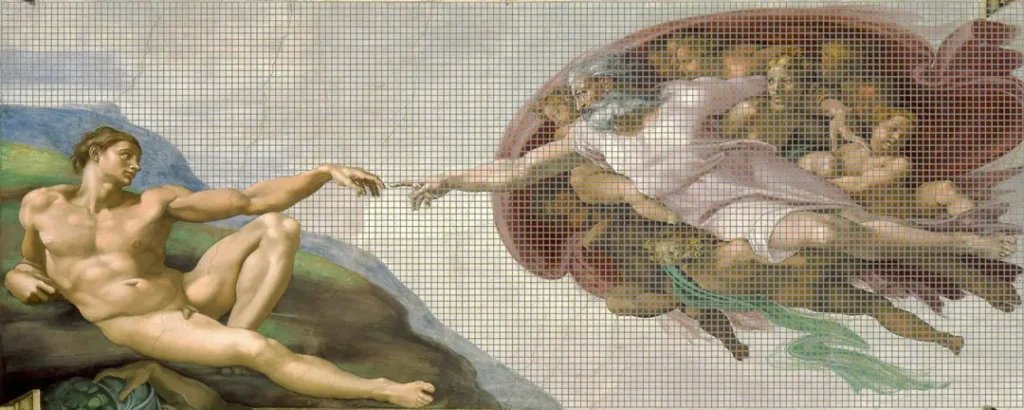
What’s out there and how it’s generated may always be screened from our direct perception and full understanding. Michelangelo’s painting, The Creation of Adam, shows Adam’s finger nearly touching the hand of God… nearly, but not quite. Adam comes about as close as you did to actually touching your phone. The screen that’s been added below begs another question: Was the master trying to tell us something with this near miss?
The technique described on this site is offered primarily to allow you to reclaim your birthright to full embodiment. However, as you periodically pull back from constant projection and into embodiment, the illusory nature of human perception may become a larger part of your everyday awareness. And you might find that you’re quite comfortable watching this magic show from within the spaciousness of your bubble of perception, as you allow the world — whatever it is — to come to you.