
Are you in your home office sitting at your monitor? Maybe you’re in a coffee shop, or sitting in the shade on a park bench scrolling your phone? Wherever you are, you’re likely surrounded by a number of objects. If you were to take pictures of them and text them to a friend, your friend would likely be able to guess where you are. In other words, your location is normally defined and revealed by the objects surrounding you.
Pick one of these objects… a book on the shelf in your office, or the barista steaming your latte, or the bark on a tree across the park. Between you and this object there appears to be space. That is, it’s clear to you that you’re separated from what you’re seeing by distance. This seems obvious, but it’s not true. You’ve been tricked. And this deception has profound implications for the question of where your true location is, and why the technique offered on this site may help you return there.
Your brain produces this locational trickery, but it starts on the retina at the back of each eye. Science tells us that visual data is displayed on each retina in only two dimensions, not three. So how do you experience the sensation of depth that appears to put distance between you and any external object… even the screen you’re looking at right now?
You perceive 3D depth largely because your two eyes give your brain separate views of an object and its background from a slightly different angle. Your neurology compares the 2D data registered on each retina in order to fabricate a 3D experience. But that’s not the whole answer. Close one eye and look away from your screen. 3D, right? Each eye has some capacity for 3D depth perception based largely on movement… yours, or that of the object you’re seeing. But there’s another factor.
Imagine that you’re the first astronaut to land on Planet M-239. You lumber out of your landing craft in your bulky space suit to peer at a completely alien landscape. As you scan across the dusty, plain surrounding your craft, you see a grove of dark turquoise trees in the distance. But maybe they’re not that far away. Maybe they’re just big bushes. It’s hard to tell. Thinking this odd-looking grove may be the best place to begin your exploration, you head out.
When you get halfway there, a thick cloud of white dust emerges from the grove. As it gets closer, you can detect the outline of a huge dark brown creature coming straight at you. Its jumble of legs churns up the dust, partially obscuring a long, massive body that shifts from side to side in a strange way. As the beast gets dangerously close, two long tentacle-like arms extend from the middle of its body and reach towards you. Somehow you make it back to the craft, climb in and close the hatch, expecting the creature to crash into your small lander any second. Then… nothing.
What happened? You glance back through the hatch’s window and witness a totally unexpected sight. You weren’t the prey. With the dust settled you see a predator casually dismembering its prey with claw-tipped tentacles. There were two animals, not one. Both creatures have the same dark brown scaly hides. Later colonists on Planet M-239 will discover that the bigger animals have identically colored hides to protect them from certain damaging frequencies their sun produces.
Their identical color created the illusion of a single animal. You were fooled because you have no visual context for Planet M-239’s animal life. Your binocular vision may not be enough to protect you here. You’d better start feeding your neurology more visual data if you want to survive on M-239. But that takes time. Your visual context developed gradually back on Earth. Back home, this visual inventory helps your binocular vision to accurately position objects in 3D as you look out at the world.
But do you really look out at the world? Science says that you don’t actually look out at anything. You didn’t look out at those weird animals on Planet M-239. You didn’t see them out there emerging from that strange foliage. The turquoise forest, the single beast that became two, the predator and its dinner — the whole visual experience took place entirely inside your head.
Your perception of any object doesn’t begin until the light reflected off that object registers on the retina at the back of each of your eyeballs an inch or so inside your skull. It’s this reflected light that’s the image you see. You never see an object out there in real time. Here’s why: This reflected light bouncing off the object travels to your retinas almost instantaneously. Almost, but not quite.
Suppose that after his meal, the predator looks up. The reflected gleam of your landing craft registers on the creature’s retinas. Sensing an intruder in its territory, it charges your lander… for real this time. As you peer through the craft’s hatch, you wonder if this big fella can rip it off with its thick tentacle arms. But you’re in luck. Your fellow astronauts in the mothership have been monitoring your situation. They’ve powered up the ship’s quantum disruptor, and have it locked on the beast. Instantly, its atoms are scattered far and wide across Planet M-239.
The reflected light from the precise instant the beast is vaporized travels at 186,000 miles per second to your retinas. But it takes a little longer for the bioelectrical data to move from your retinas to your brain’s visual center where it’s translated into an image of empty space where the creature used to exist. Yet, before this new image reaches your awareness, your neurology continues to show you the old image of the predator charging your landing craft. For the briefest amount of time, you saw a ghost image of a creature that didn’t exist.
Any movement in your perceived visual field is always delayed by the tiniest amount of time relative to what’s actually going on in the external world. The speed of light is a very small part of this delay. Most of the delay is due to the time it takes for your brain to catch up to what just happened out there. Back on Earth, this delay is imperceptible and doesn’t affect your ability to catch a ball or make a left turn in traffic. But the scientific truth is that whenever you see something move, you’re seeing a ghost. The only time you can truly appreciate this ghost-like delay is when you peer up at the stars…
You’ve had more than enough of Planet M-239 for today and you blast back up to the mothership for a hot shower of recycled water and a couple of cold beers. As you sip, you stare out a porthole at the stars and remember that it’s taken millions of years for their light to reach you. Then, you realize that you’re not actually seeing the stars. They’ve moved. And, like the ghost image of the predator down below, it’s likely that at least one of these twinkling lights you’re “seeing” is a ghost image of a star vaporized by a supernova eons before your eyes began to develop in your mother’s womb.
Your experiences on M-239 produced some exaggerated examples of the strange nature of visual perception. But it’s time to go home and look at some of the subtler aspects of how your neurology manufactures experience. Let’s say your spacefaring days are over and you’re enjoying a well-deserved NASA pension. You’ve stopped at your favorite coffee shop for a latte. It’s a beautiful spring morning, so you cross the street and sit on a park bench.
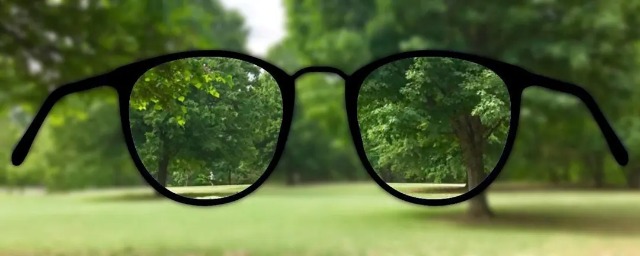
You notice a kid way across the park. Your grandson comes here often with his soccer ball. Could that be him? You’ve become nearsighted since your astronaut days, so you reach for your glasses. Before you put them over your nose, you notice that you’re seeing both the corrected view in the lenses and the uncorrected view around the rims.
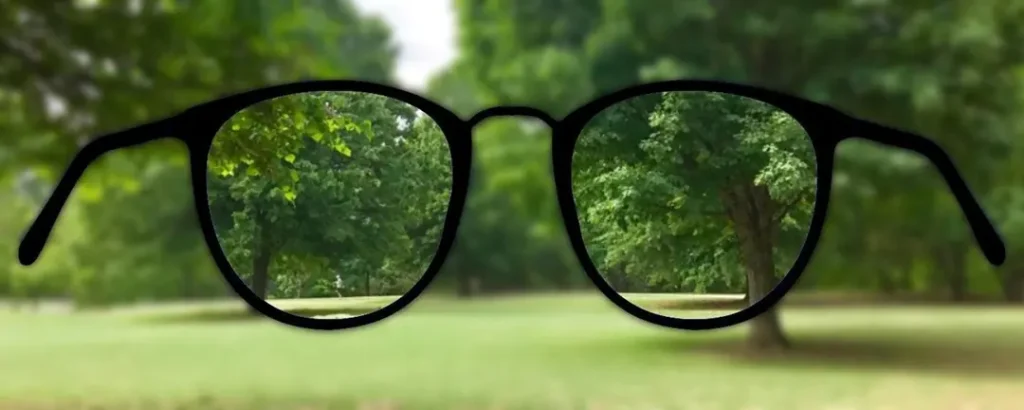
You put on your glasses to get a better look at the kid way out there. But the truth is that you’re not looking way out there, though the muscles in your neck and around your eyes strain in the attempt to do so. You’re seeing two much closer images displayed on the inner surfaces of the lenses that are less than an inch in front of your eyes. But that’s not quite true either, is it?
You’re not even looking out at an image an inch away on your prescription lenses. After it passes through your glasses and is bent correctively to your optometrist’s specifications, this reflected light continues its path to the back of your eyeballs. This is where you perceive the now crystal-clear illusion that you’re looking at a kid out there. The image of the kid is entirely in your head.
Look again at the graphic above. Notice how you’re automatically projected out into the clearer view inside the lenses. This hints at how non-stop thinking, paired with visualization, projects your sense of self forward. Now consider that the clearer, corrected view appears to have depth, while the distorted view outside the glasses seems much flatter. Yet, the truth is that both views are being displayed as a single two-dimensional image on your retinas.
Let’s take this a step further. Even with your glasses on, you can’t tell if this kid is your grandson. So, you take off your glasses, pull out your phone and focus its telescopic camera on the kid. “Not him.” But before you put your phone down, you notice that you can see two images at once…

You see the boy magnified on your phone. And to the left of the phone, you see the surrounding park. But you’re not fooled like you were by the alien beasts on M-239 that seemed to be a single animal. Your past visual experiences confirm that the kid’s blown-up phone image is a two-dimensional trick of technology. Though fuzzy, it’s your normal view around your phone that tells you what’s actually happening in three dimensions way out there, right?
Once again, there’s only one image. Like pasting a picture cut from a magazine into the middle of a larger paper collage, there’s only a single two-dimensional display hitting your retinas. It’s only your visual inventory that informs you that the camera image in the middle of this collage is not accurate in depth, while the fuzzy image around the phone is. This entire visual experience — like everything else that you have ever seen or will see — is being displayed on the two-dimensional surface of your retinas an inch or so inside your head. You never really see a world out there.
But it’s not only reflected light that your neurology translates into what appears to be 3D sensations. Your hearing is also a manufactured translation. Let’s say you’re still sitting on the park bench. The sun has come out and is beaming down on you, making you drowsy. You lean back and close your eyes for a few minutes. A bus rumbles along the street behind you, but you don’t need to open your eyes to track it. Even with your eyes closed and your back turned to it, you can easily perceive its direction, and you can even gauge the approximate space between you and the bus.
This placement in three dimensions begins as sound waves from the bus reach your eardrums an inch or so inside your head. But like the visual data reaching your retina, the eardrums don’t receive any 3D information. As the term implies, your eardrum is simply a drumhead. Sound travels to each eardrum as one-dimensional waves. But once your eardrum is struck, it vibrates in three dimensions like a pond hit by a pebble.
Your neurology compares the vibrations reaching each eardrum to create the sensation of the sound’s direction and distance. In other words, your neurology manufactures the illusion that the sound waves coming to your eardrum in one dimension are distant 3D sounds. Like the objects you perceive visually, these sounds are not out there. It’s all in your head.
Because sound waves travel so much slower than light waves, you can experience sound’s ghost-like nature. When your grandson hears an echo in a canyon, he’s delighted by the delay. And when you’re with him in a ballpark’s outfield bleachers watching a fly ball, you can explain to him why he saw the ball hit a half second before he heard the crack of the bat. But it never occurs to you that the reflected light from the ball also took time to radiate into your head… just a whole lot less time.
Normally when you see an event that also produces sound, you’re not in the bleachers. In your everyday “close up” experiences, light and sound from an event seem to be simultaneous. But light and sound always race to penetrate your head. Light always wins, though you almost always experience the race as a tie. And this supports your perception that you’re witnessing a unified event occurring out there. But the truth is that your neurology projects the illusions of vision and hearing quite independently.
Do your other three senses project sensation? And do any of these three interact, like vision and hearing do, to create the illusion of a unified experience? Here are some hints: Like vision and hearing, two of these senses are inside the head. One of these two never projects perception. The other one does, but not as much as it used to.
The third one is quite unique in being the only one of your senses that operates outside your head. And this one may be even more critical than vision and hearing for navigating and experiencing what appears to be the external world. Could you have driven your grandson to the ballpark if you couldn’t feel your right foot so precisely depressing the gas pedal, or if you couldn’t feel your hands controlling the steering wheel? Surely there’s no illusion to what you can grasp and hold. Or is there?
_______________________________________________________________________________
Part 2 [Coming soon] explores what’s really happening when you reach out and touch an object in the external world.
Titled “Where You Are,” Part 2 also answers the original question posed at the beginning of this blog.